

open mobile menu

Helene's Blog

GOVERNOR ANDREW M. CUOMO'S PSEG/LIPAGATE - A COMMUNITY'S TRAVESTY
wires

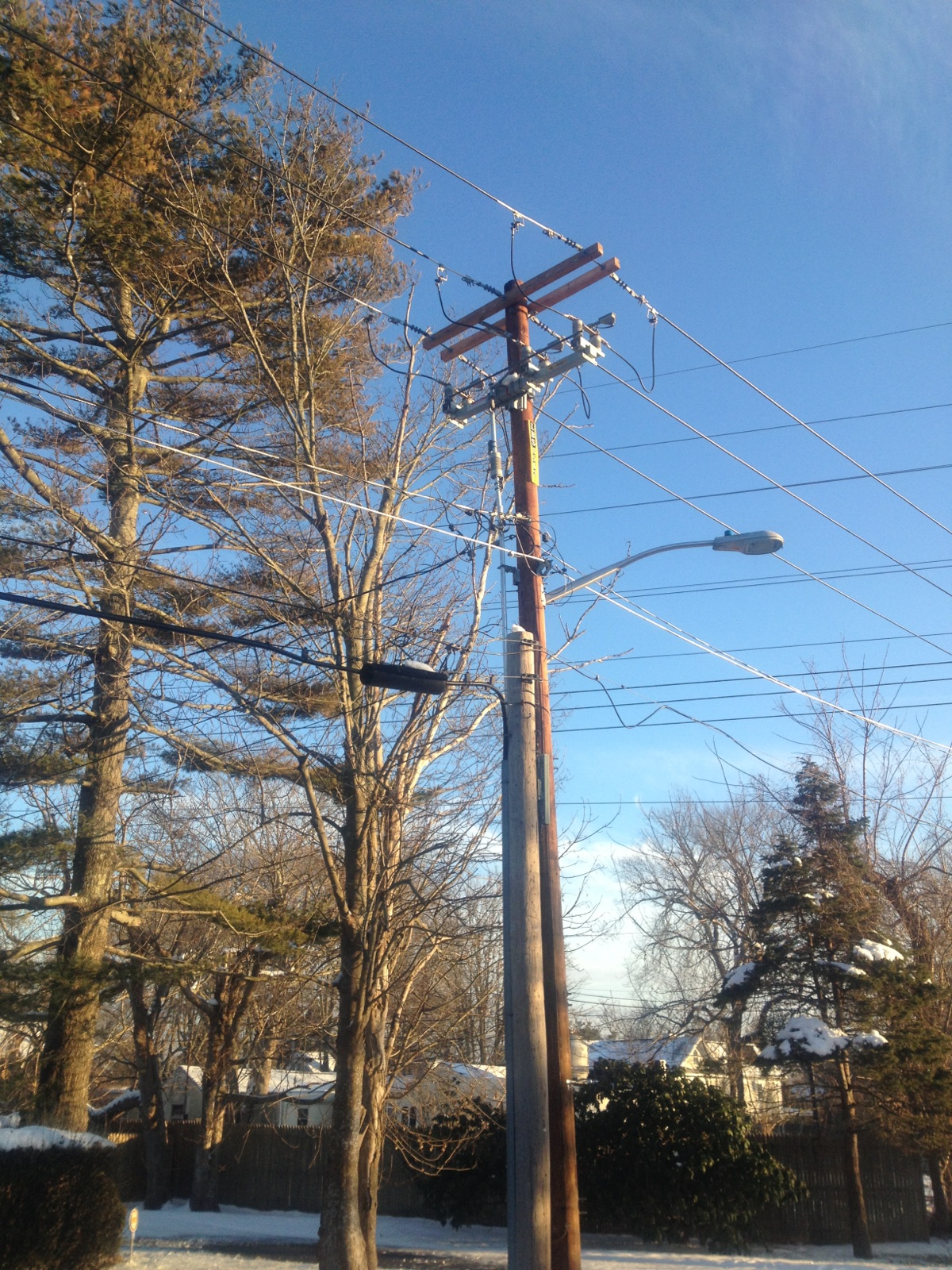
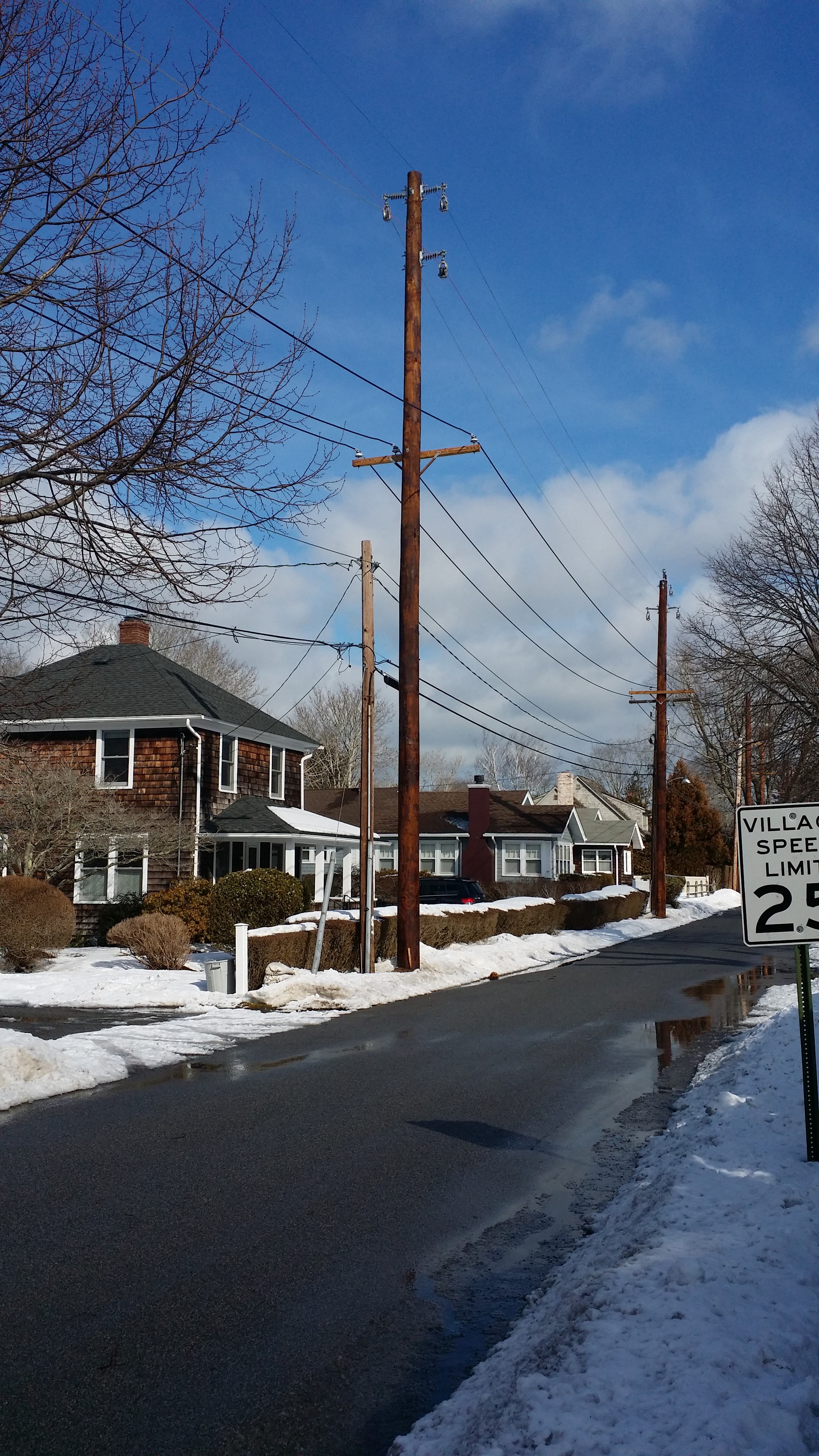
I'm sorry to say that it's been almost two months since I've blogged. I've been rewriting my new YA novel, Flat-Tops and Ponytails -1969 and alerting, educating, and organizing my neighbors regarding a community travesty that has befallen us. Our East Hampton community, voted one of the most beautiful villages in America, is under siege. Governor Andrew M. Cuomo, hired PSEG, a New Jersey based utility company to take over Long Island's antiquated electric system. What Governor Cuomo failed to tell the people of Long Island was that the contractual agreement he signed with PSEG-LI provided the utility with free reign to butcher our trees, install toxic 52 to 61 foot poles within 25 feet of our homes,  pollute our scenic vistas, pollute our groundwater and soil, devalue our property values, and string high-tension lines along quaint, narrow village streets 25 feet from our children's bedrooms.

This is an outrage!

In 1863, President Abraham Lincoln reminded Americans that "this nation, under God, shall have a new birth of freedom - and that government of the people, by the people, for the people, shall not perish from the earth." Actions speak louder than words. The actions of the Governor, our local officials, and PSEG-LI have demonstrated that this is no longer a government of the people, by the people, and for the people.

If the governor thinks he’ll win our votes by allowing PSEG-LI to bulldoze their way through our villages and towns, installing 61 foot toxic poles along scenic roads and tiny quaint village streets, he’s mistaken. These high-tension wires are known to cause the following:  brain tumors, childhood leukemia, breast cancer, miscarriages, birth defects, lymphomas, depression, fatigue, headaches, aggravate the onset of Alzheimer’s and dementia and other known cancers, burning and/or tingling of the skin, and rashes for a starter. These fifty-six to sixty-one foot poles are rated for 130 mile an hour winds. What happens if and when we get a hurricane like the one we had in ’38? If these poles were to fall, they will fall on homes, homes with people and pets – the very same people who voted the governor into office. If these poles should fall in front of our firehouse, our first responders will not be able to get the trucks out to help local residents. The chemicals that have been applied to these poles smell badly. Residents in NJ claim that they are suffering from upper respiratory illnesses caused by the poisons used to preserve these poles. The chemicals used on these poles are toxic and carcinogenic and are leeching into our soil and ground water. The chemicals used on these poles have been outlawed on wood structures that are built in our playgrounds. In the HUD manual it states that a real estate appraiser should note if the property in question is near high-tension wires – if it is, lenders are advised not to lend money. There is no denying that Long Island needs to upgrade its electric system, but it needs to be done in a responsible, safe manner.

STOP THE POLES – BURY THEM UNDERGROUND.
 PetitionPhotoByMike-Feb.14,2014

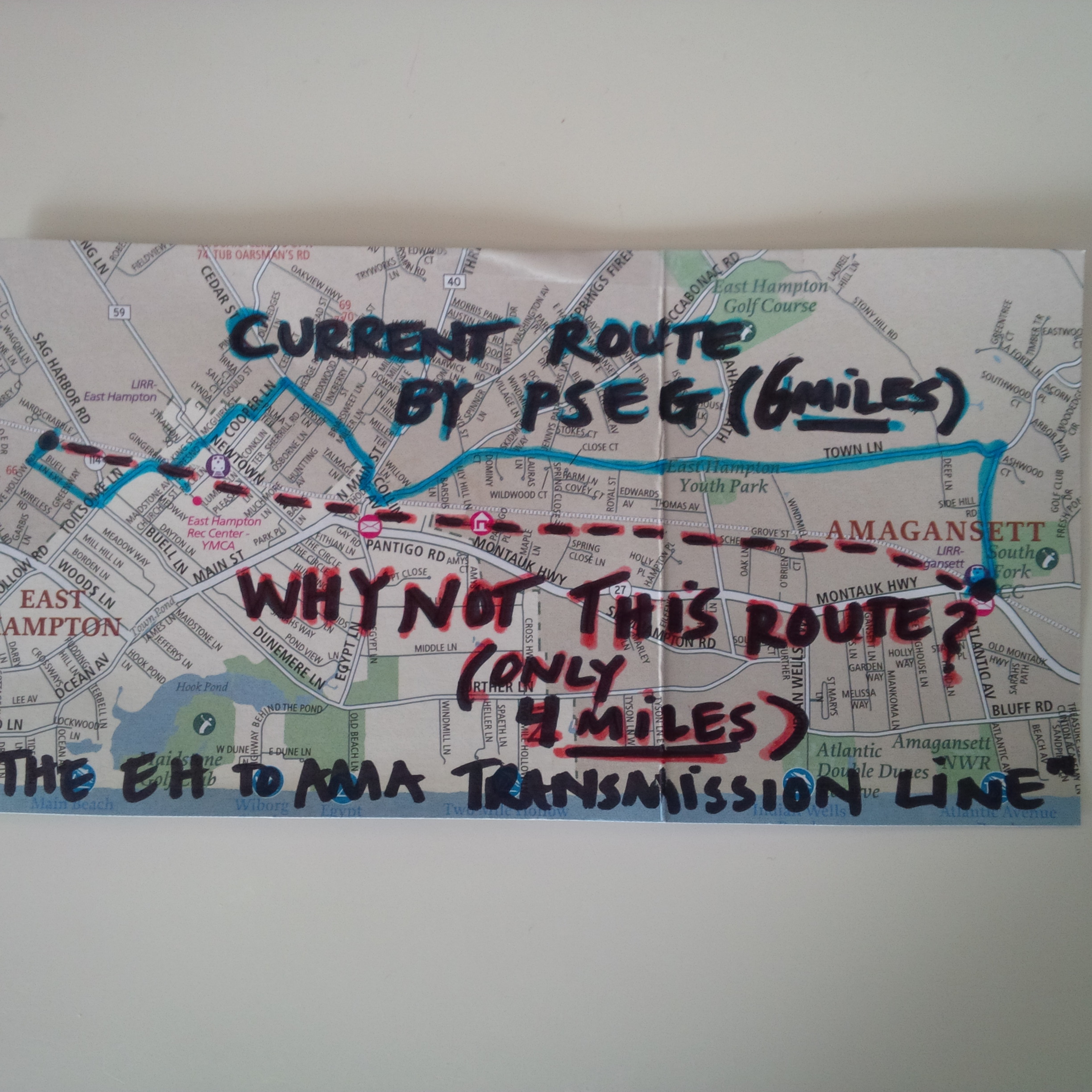
 This is a travesty created by the governor, and he’s the only one who has the ability to stop it. Who says that things in motion can’t be stopped?  In the late 1980’s, the governor’s father, former Governor Mario Cuomo, conceded that the on-line Shoreham Nuclear Reactor needed to be shut down. There was no safe evacuation for Long Islanders.  There’s no reason to think that any project PSEG has begun can’t be stopped. Anything in motion can be stopped – All the governor needs to do is stop it.  PSEG-LI failed to notify the majority of residents living along the 6 mile East Hampton to Amagansett transmission line project. We were denied a voice due to this failure to notify.  PSEG hasn’t followed our East Hampton 2005 Comprehensive Plan.  PSEG hasn’t created a reliable and responsible 21st century upgrade for Long Island’s electric system.  PSEG has ruined our scenic vistas.  PSEG has disregarded our historic sites.  PSEG has put our residents in an unhealthy environment.  PSEG has contaminated our drinking water.  PSEG has devalued our property values.  PSEG has disregarded our safety.

 The governor recently held a phone - town hall meeting where he asked residents to contact their local state representatives asking them to encourage small local towns and villages to reduce their overhead spending by 1%. If the local government is successful, the Governor will "throw us a carrot" - he'll freeze our property taxes for a year.

So why is the governor wasting our money? Every day he allows this utility to continue work on this high-tension installation, he's spending money that doesn't need to be spent.  The governor needs to let this utility off the hook. David Daly, the chief-operating officer for PSEG-LI, has told us that they are under a contract to finish this project before summer 2014 or else they will be fired. The Governor needs to let them out of that part of their contractual agreement, so that they can stop and reevaluate the situation at hand.

When you look at this map you wonder why they zig-zagged though 6 miles of  tiny village roads and scenic town lanes instead of putting the lines on a direct route from one sub-station to another - only 4 miles in length, and not impacting anyone or anything.
 IMG_00000753

The Governor needs to contact PSEG-LI and tell them that they will not be fired if they stop the installation.

The Governor isn't doing his job - to protect and serve the people of the state of New York. He needs to stop this travesty immediately.

 Our goals are clear:
  1. Instruct PSEG to immediately stop all work on the new transmission line between East Hampton and Amagansett.
  1. Insist that PSEG remove all newly installed utility poles.
And finally,
  1. Demand that PSEG reroute the transmission lines underground along the Long Island Rail Road major corridor.
This is the safest, least invasive, most cost effective direct route for the East Hampton Community. We are asking Governor Cuomo to use the FEMA money he received from the federal government to upgrade our electric grid. The longer he hesitates to stop this travesty - the more expensive this project becomes. Why do we need to pay for the utility company to put up the toxic poles, take the toxic poles down, and then to bury the high-tension transmission lines. If he were doing what he's asked local governments to do - he'd be doing the least expensive, safe, reliable upgrade available to us. East Hampton’s Comprehensive Plan includes putting all future power lines underground. We want to:

·         Minimize electromagnetic fields.

·         Stop the butchering of our trees.

                        ·         Improve the safety of our roads, and,                         ·         Improve the aesthetics of our town. 

 Putting the poles underground is the only responsible 21st century upgrade.

Governor Cuomo frequents East Hampton when he needs to raise money for his political campaigns. Scott Martella, the Governor's Suffolk County regional representative told me that the Governor had no intention of stopping this installation. What's up with that?

First it was Nixon and Watergate; then it was Christie and Bridgegate; and now it's Cuomo and PSEG/LIPAGATE. What a disappointment our federal, state, and local representatives have been with response to this horrific situation.

It is our Democratic right to peacefully protest and voice our opinions. It is our right and our responsibility. This is how we create change. Margaret Mead was right when she said that, "Never doubt that a small group of thoughtful, committed citizens can change the world; indeed, it's the only thing that ever has."


Recipe For A Happy Marriage

In the forty-three years I've been married to my high school sweetheart, I've learned that it takes a lot of work to keep a marriage alive and healthy. There's a poem I came across a few years ago that captured for me the essence of the inner workings of a happy marriage. I framed the poem and hung it in our laundry room, a space we use often. Every once in a while I stop to reread it, to remind myself of its ingredients. For me, there was a touch of magic in this inspirational poem. I hope you love it as much as I did.

Recipe For a Happy Marriage

1 cup consideration
1 cup courtesy
2 cupfuls flattery carefully concealed
2 cupfuls milk of human kindness
1 gallon faith and trust in each other
2 cupfuls praise
1 small pinch of in-laws
1 reasonable budget,
a generous dash of cooperation
3 teaspoons pure extract of "I'm sorry"
1 cup of contentment
1 cup each of confidence and encouragement
1 large or several small hobbies
1 cup of blindness to the other's faults

Flavor with frequent portions of recreation and a dash of happy memories. Stir well and remove any specks of jealousy, temper, or criticism. Sweeten well with generous portions of love and keep warm with a steady flame of devotion. Never serve with a cold shoulder or hot tongue.

Serves:  Two

Yields:  One Happy Couple

- Author Unknown

GOODREAD'S INDIE EXTRAVAGANZA!

During the entire month of April, Goodread's, Rory McLeod, moderator of YA Reads for Teachers, will be hosting an "Indie Extravaganza." The Journey of Hannah Woods will be one of the featured Indie books of the month. Join Us for lively discussions throughout the month! hannawoods To order the book from Amazon CLICK HERE  

https://twitter.com/i/redirect?url=https://twitter.com/YAReadsForTeach?refsrc=email&t=1&sig=9f363ebc1cb5f4b40bf4eacb3623cf46bfb30839&iid=07fb0f7a71a143e5b64f22679aebfe9c&uid=874354316&nid=23+1100
Rory McLeod
@YAReadsForTeach
Moderator of YA Reads for Teachers (And Any Other Adults!) on http://t.co/vg9DH2Q6.
http://www.goodreads.com/group/show/19451.YA_Reads_for_Teachers_And_Any_Other_Adults_
 
https://twitter.com/i/redirect?url=https://twitter.com/YAReadsForTeach/status/443815222470770688&t=1&sig=3702845279a925572da3530dcbb74c6c1a1d7428&iid=a8043b082fb04e3ba62411ffa7f8e81e&uid=874354316&nid=4+1262
Rory McLeod @YAReadsForTeach

@HeleneForst will be our guest during the INDIE EXTRAVAGANZA! Enter to win a copy of her book! goodreads.com/topic/show/173

"Peace cannot be kept by force." - Albert Einstein
20131216_165444

In 1958,  Gerald Holtom, a British conscientious objector, drew a sign to stand for nuclear disarmament. The symbol was a combination of the letters N and D taken from semaphoric signals used by the British navy. Over the years, this symbol became a universal symbol for peace.

In the late 1960's, hippies first used the symbol to represent peace rather than just for nuclear disarmament. Today it is seen on clothing, banners, buttons, jewelry, and painted walls throughout towns all over the world. It's an extraordinary example of branding that has become embedded in our every day lives.

Holtom's design was created to remind us of the dangers of the nuclear industry, be it the waste from nuclear power plants, the death and suffering from nuclear fallout, or the destruction from radiation poisoning for future generations.

The threat of nuclear proliferation still remains today as wars continue to be fought all around planet Earth. Isn't it ironic that Albert Einstein once said, "Peace cannot be kept by force. It can only be achieved by understanding."

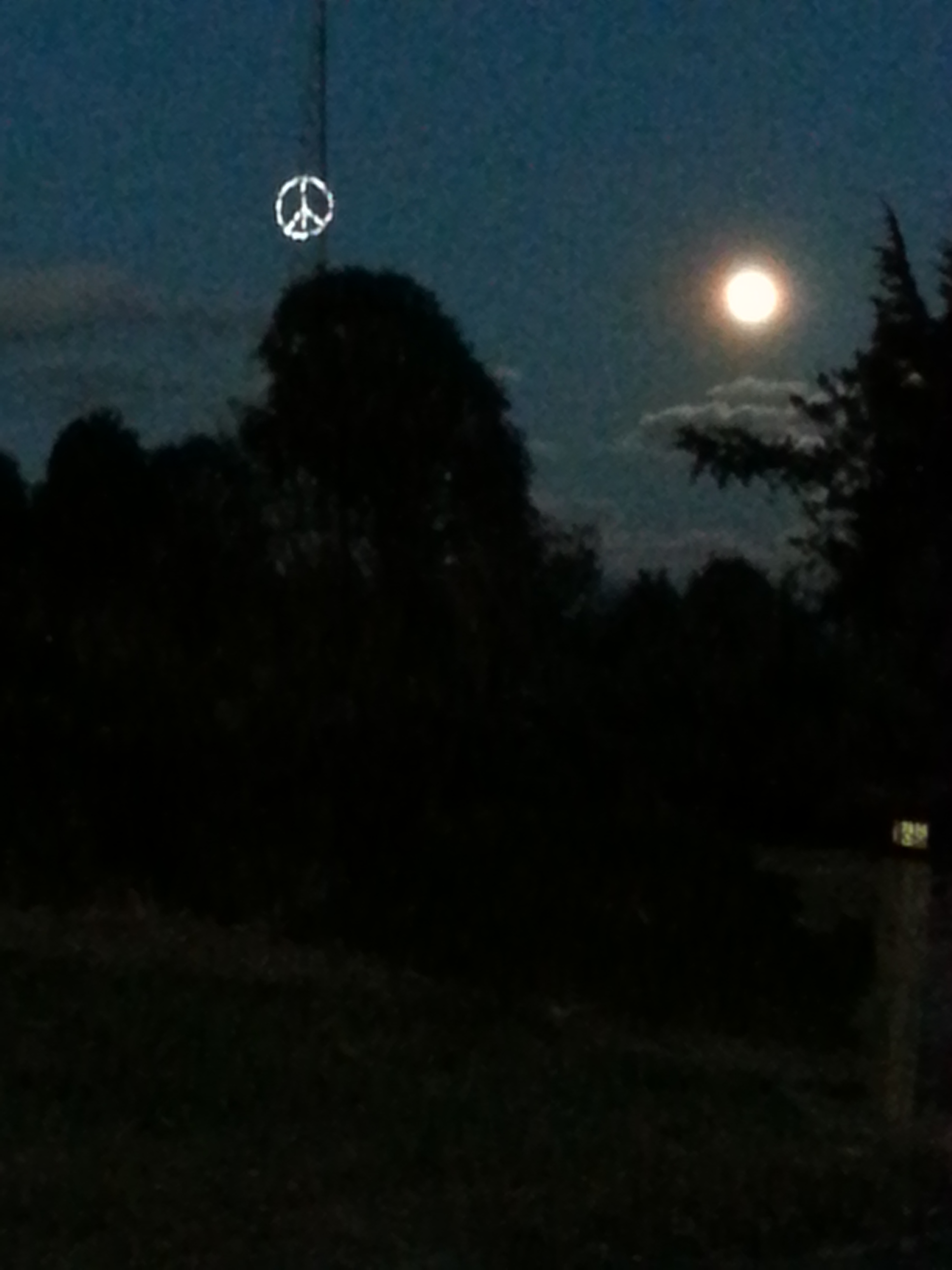
Native Americans referred to the December full moon as the Full Cold Moon or the Full Long Night Moon for during the month of December, nights grew longer and darker and the winter cold gripped the earth. The full moon won't be seen tonight because of the clipper snowstorm that passed over Long Island today. The skies are dull grey and the rain is washing the little bit of snow we had away. Last night, however, I got a picture of the moon over Long Lane in East Hampton, New York. The scene captured for me the spirit of the season - a softening of hearts and a universal search for peace.

It is my wish for our world that peace dwell in our hearts, our homes, and in our world. Happy and Healthy holidays to everyone and Peace to all mankind!

Falling Through The Cracks

As I continue with the rewrite of Stoked, my YA novel about Jake Edwards, a thirteen year-old boy with dyslexia growing up in the 1960's, I realize that our educational system continues to be flawed. Our teachers continue to be poorly trained; one out of five students, roughly 20% of the student population, struggles with reading. This is a statistically significant number of children. I keep wondering, why is it that children with dyslexia are still being told that their brains are broken and bad? No child should be left to fall through the cracks. The Orton-Gillingham method of instruction isn't just a method of instruction for dyslexic students; it's a great educational method for all children. Multi-sensory, direct, explicit, sequential, cumulative, language-based instruction is just good teaching. In order to be a successful reader, a child must master the sound system of our very complex language. The Orton-Gillingham method for teaching reading is based on the fundamental principles of the structure of the English language. This multi-sensory approach can be adapted to all content area subjects. It's time that our educators recognize that a person with dyslexia learns differently, and that it's their responsibility to teach to these learning differences. I doubt if dyslexia was a disability before the invention of the printing press. A dyslexic brain is a gift; these are the brains that think globally. These are the visual-spacial, critical thinkers who see the bigger picture of things. These are the problem solvers who think in images. The neurologist, Norman Geschwind believed that, "dyslexia was nature's way of producing different brains. In so doing, a survival mechanism of the human race was created to do things that the human race never knew it needed to be able to do." Speaking, a natural thing for humans, has been around for hundreds of thousands of years, but writing and reading have only been around for five thousand years. Our brains are not hard-wired for reading as they are for speaking. During the time of the cave man, a dyslexic brain would have been honored, for those were the people who could problem solve, could think outside the box for the good of the group. I am evolving with my protagonist, Jake, rooting for him to overcome the emotional baggage he picked up as he struggled in school. As I researched dyslexia, I came upon an awesome book called. Dislecksia: The Book, by Harvey Hubbell V. Harvey invited people to bring his documentary, Dislecksia: The Movie, for a pre-screening event in their home town. Harvey is dyslexic. He wants to spread awareness about what dyslexia is, how it can be treated through education, and how it is an advantage instead of a disability. DIS-400x600_R3 I am hoping to bring Harvey out to the Hamptons where he'll host a screening of the movie. It's time for our educators and our administrators to understand that cracking the code isn't about intelligence. It's about adopting a successfully prove, scientifically-based, educational model that works. Check out the film's website at: www.dislecksiathemovie.com.    

Study Skills Workshop for Independent Learning

diary journal book

Save the Date - Wednesday, June 18, 2014


Overview:  Organizational Study Skills Workshop

An Introduction to the Landmark Master Notebook System

In a hands-on, multi-sensory  approach, this workshop will cover the following topics:  Organizing time, materials, and information; reading textbooks, recognizing and formulating main ideas and details, taking notes from written and oral sources, summarizing and paraphrasing; and test preparation. 

Learn how study skills instruction can be adapted to regular content classes.

For more information contact Helene Forst at: https://heleneforst.com

Professional Development/Orton-Gillingham Training

INTRODUCTORY TRAINING

One day Workshop - Wednesday, June 25, 2014

Why Orton-Gillingham? This method of teaching provides multi-sensory, direct, explicit, sequential, language-based instruction that empowers educators with the fundamental principles of the English language. The approach can be beneficial not only for students with dyslexia, but for all students. This approach incorporates the five basic components essential to an effective reading program:  phonemic awareness, phonics, vocabulary development, fluency, and comprehension.

After participating in this hands-on training, participants will acquire the tools necessary to understand the fundamentals of multi-sensory instruction and the principles of the Orton-Gillingham method.

You will learn:

                                 Multi-sensory strategies for reading, writing, and spelling

                                 Phonemic Awareness

                                 Syllabication patterns for decoding and encoding.

                                 Student Assessment Techniques

                                 Guidelines for daily and weekly lesson plans

Contact Helene Forst at:  https://heleneforst.com

The Full Hunter's Moon

October is the month of the Full Hunter's Moon. This is the first full moon following the Harvest Full  Moon of September. Some Native American tribes gave the full moons names to track the seasons. The Algonquin tribes, who lived in the northeast region of the United States, referred to the October full moon as the Full Hunter's Moon, as it was the time to go hunting in preparation  for the long, cold winter months. October is the month when the leaves are falling and the air turns clear and crisp. This year, the October full moon occurred on Friday, October 18th. It rose around sunset and set around sunrise, the only night in the month when the moon was in the sky all night long. The day before October's full moon, my husband, Jack, and I, and our two very best friends, Gary and Vikki , traveled up to the north country of the Adirondack mountains to hike its trails and canoe its ponds. On the day of the full moon, we hiked to Winch Pond, a 3.8 mile round trip, moderate hike, past Owens and Copperas Ponds. We came upon a section of the trail that had flooded out. To the right of the trail, Gary noticed that many of the trees had been fallen by the gnawing of beavers. Scattered upon the surface of the  water were hundreds of freshly shaven pieces of gnawed tree bark. We realized that the swampland had been created by beaver activity in the area. To our amazement, we spied a grand beaver lodge in the distance. It was huge. We waited in silence hoping to see a beaver at work, but they must have been on break, or perhaps they were watching us, and waiting for us to move on.  As we continued on the trail, I imagined what creatures were silently watching us. Black bears and mountain lions and bobcats and moose frequent the same mountains we were hiking in. That night, we sat on our porch in the inn we were staying at, and watched the full moon light up the lake. My body relaxed as it melted into the energy of the landscape before me. The following day, we canoed Floodwood Pond and portaged into Fish Creek. We had one adventure after another, some more challenging than others. We laughed a lot, and breathed in the magical world of the wilderness. Paul Scott Mowrer, an American correspondent, and Pulitzer Prize winner for Correspondence, once wrote that, "There is nothing like walking to get the feel of a country. A fine landscape is like a piece of music, it must be taken at the right tempo." How true, I thought to myself, as we paddled our way past a deserted island. The air was alive with a freshness not found in many places. In the early 1900's, people would travel to the Adirondacks to recover from Consumption, also known as Tuberculosis, the number one killer in New York City during these early years of the 1900's. The autumn leaves had fallen by the time we'd arrived in the mountains. We'd missed the yellows and oranges and reds of the early days of October. The feel of the country was both awe-inspiring and frightening all at the same time. We knew that it was important to stay alert, be prepared for the unexpected, and to remain calm in all situations. The wilderness is like a wild beast; it deserves our respect. We knew that the weather can change rapidly in the mountains, yet, when the winds picked up to gusts of 29 miles per hour, we were uncomfortably surprised. Our return voyage to the Floodwood trailhead was going to be a rough one. Jack and I were in individual, 12 foot canoes. We were managing okay as white caps appeared along the surface of the pond. The water looked darker and colder. Gary and Vikki were in a double Keflar canoe that was giving them a lot of trouble. One fierce gust of wind tipped their canoe, and it filled with water. For a moment, my mind began spinning, remembering everything I'd read about  hypothermia.

Fortunately, we were paddling close to shore. Jack managed to climb out of his canoe and helped them right their canoe. They were soaked. We headed  back to the Floodwood trailhead; I had felt fear as we paddled through this magnificent landscape. The music  blared as we dealt with the crisis; my heart pounded in my chest. As our canoes glided swiftly to our destination, the music switched once again, its melody became calm and mellow . We 'd been notes in the music that had played  that day.

"Away, away, from men and towns, To the wild wood and the downs - To the silent wilderness Where the soul need not repress Its music, lest it should not find An echo in another's mind, While the touch of Nature's art Harmonizes heart to heart."

                 -Percy Bysshe Shelley
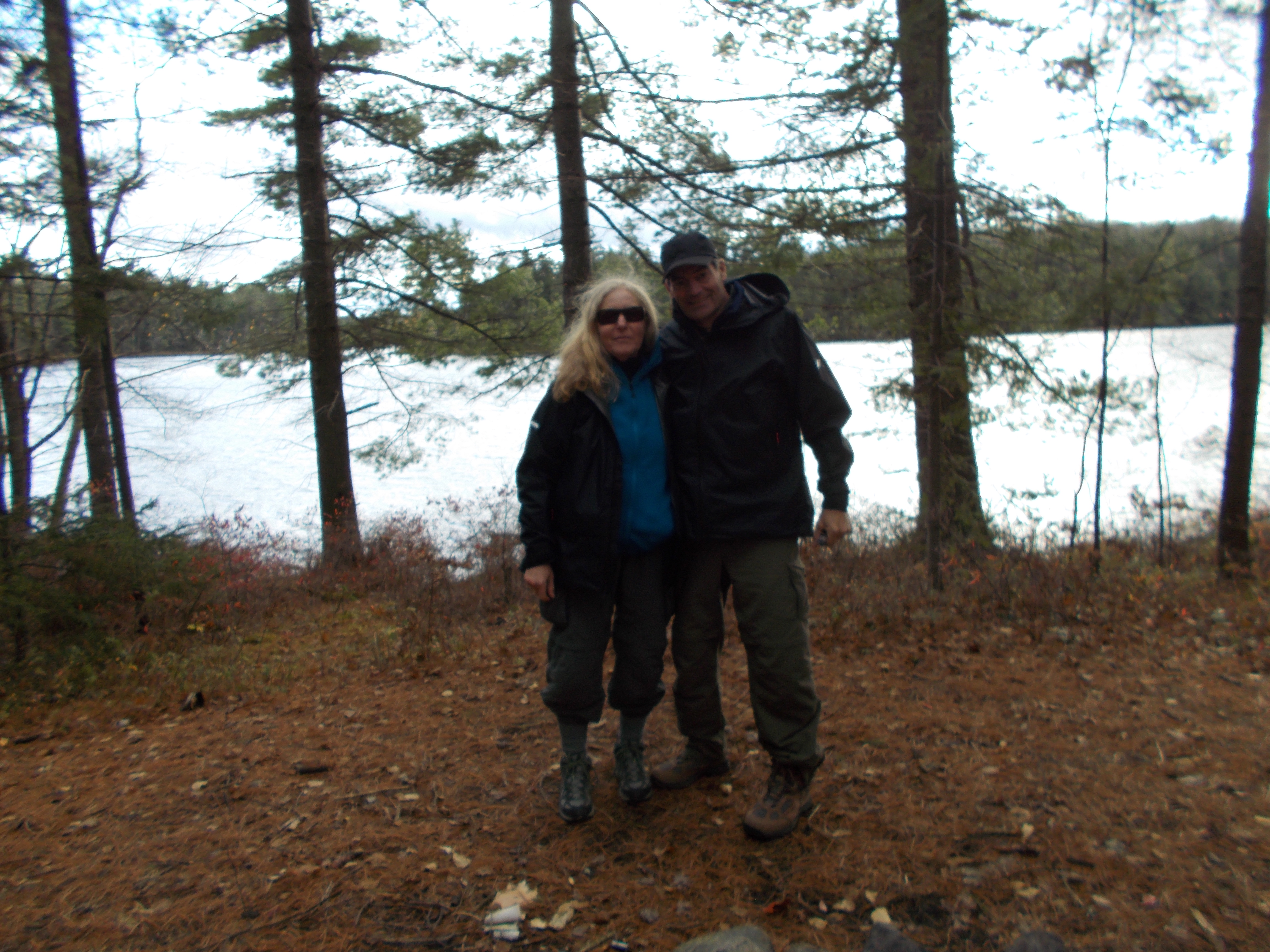
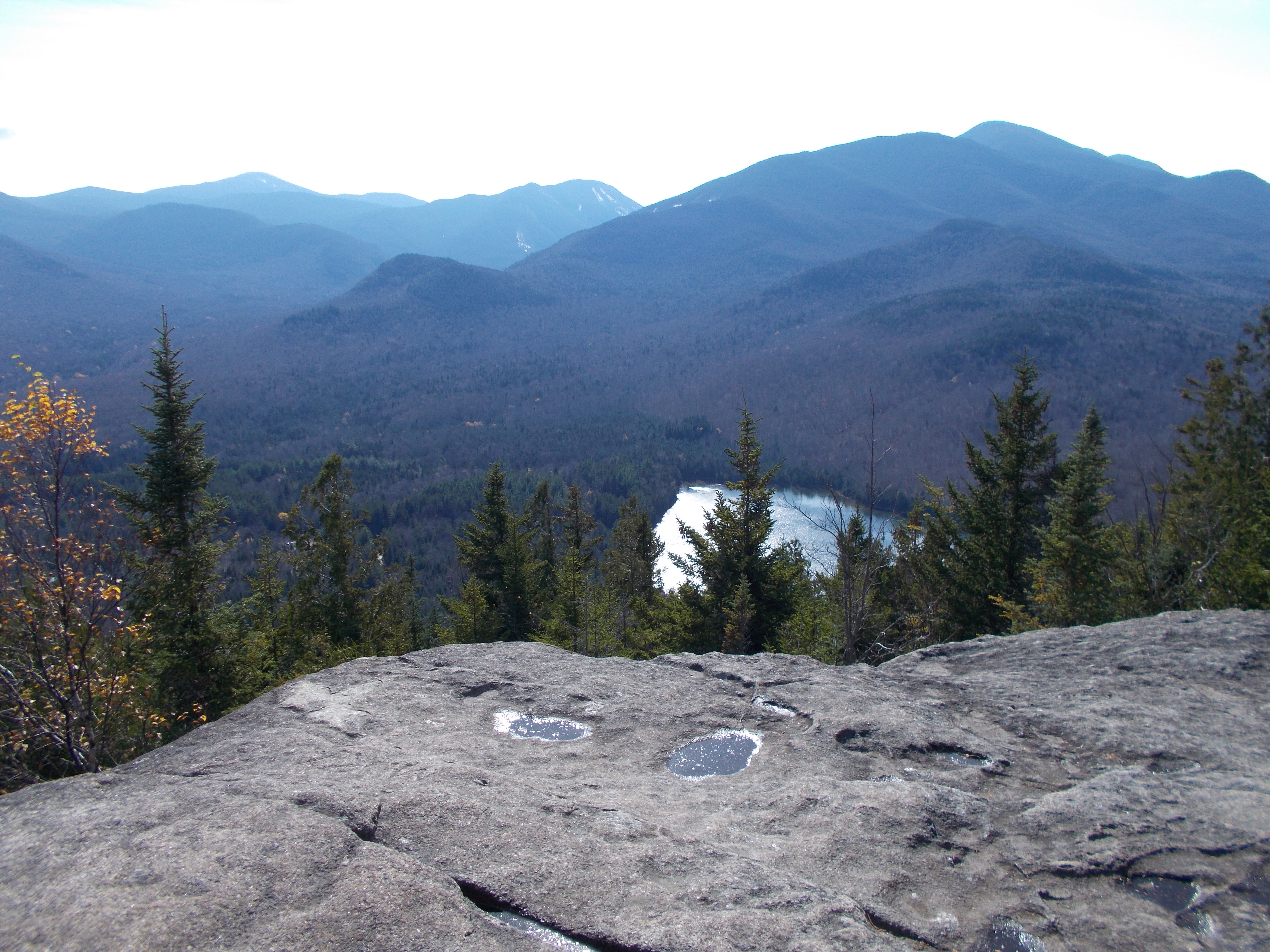
  LakePlacid-Oct.2013 003 We had heard the symphony of the landscape, the lapping of the water upon the shoreline, the wind blowing through the towering pines, and the clear whistled Blue Jay calls alerting each other to our presence. We had been a part of the music. The final picture below is taken from the top of Mount Jo. It's a picture of Heart Lake where the loj, pronounced lodge, of the Adirondack Mountain Club, is located. We had been in the heart of the Adirondacks; we had heard its music; we had joined in its heartbeat, and moved to its rhythm. I knew that I lived a blessed life.LakePlacid-Oct.2013 037
A Leap Of Faith

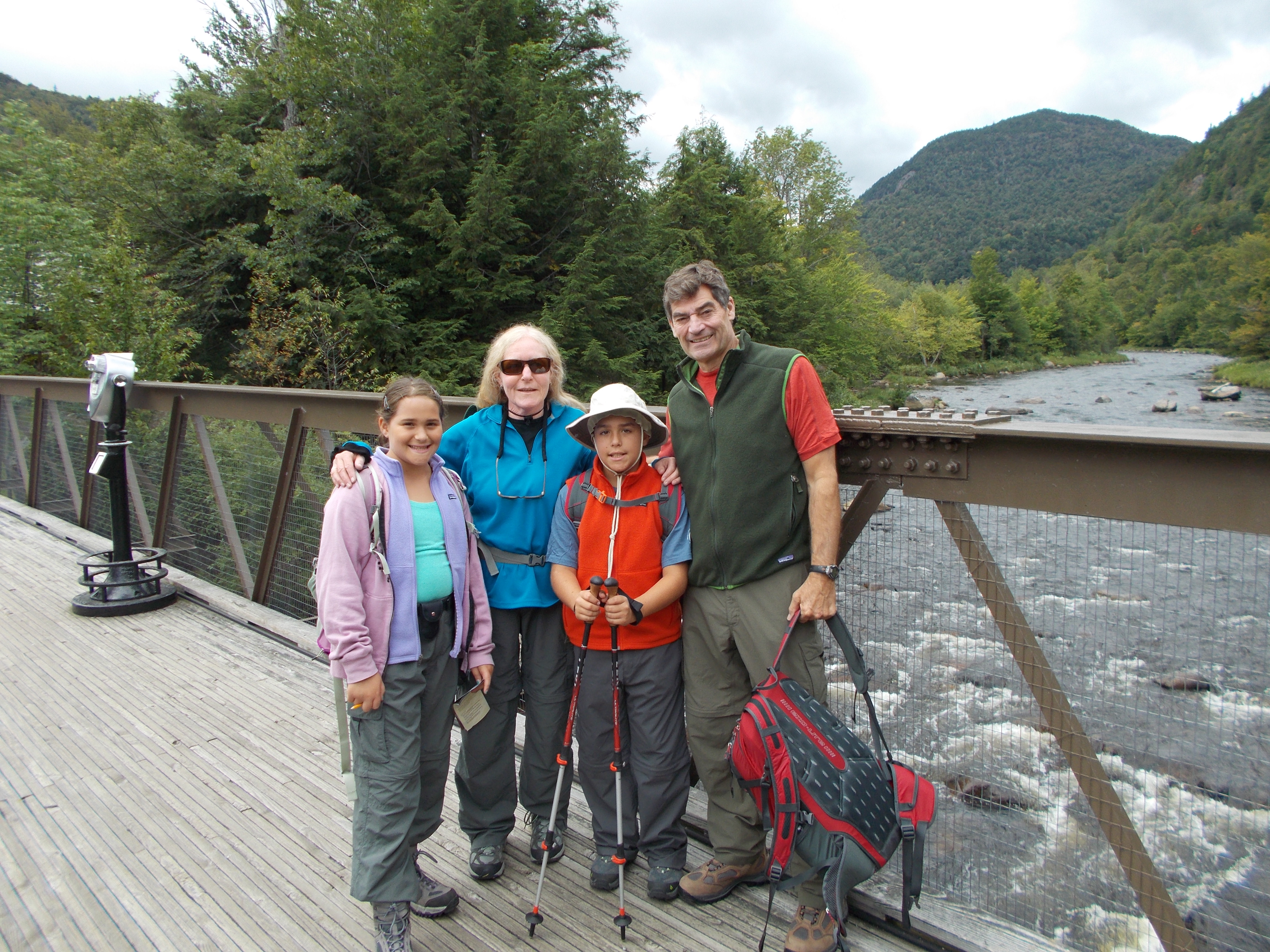
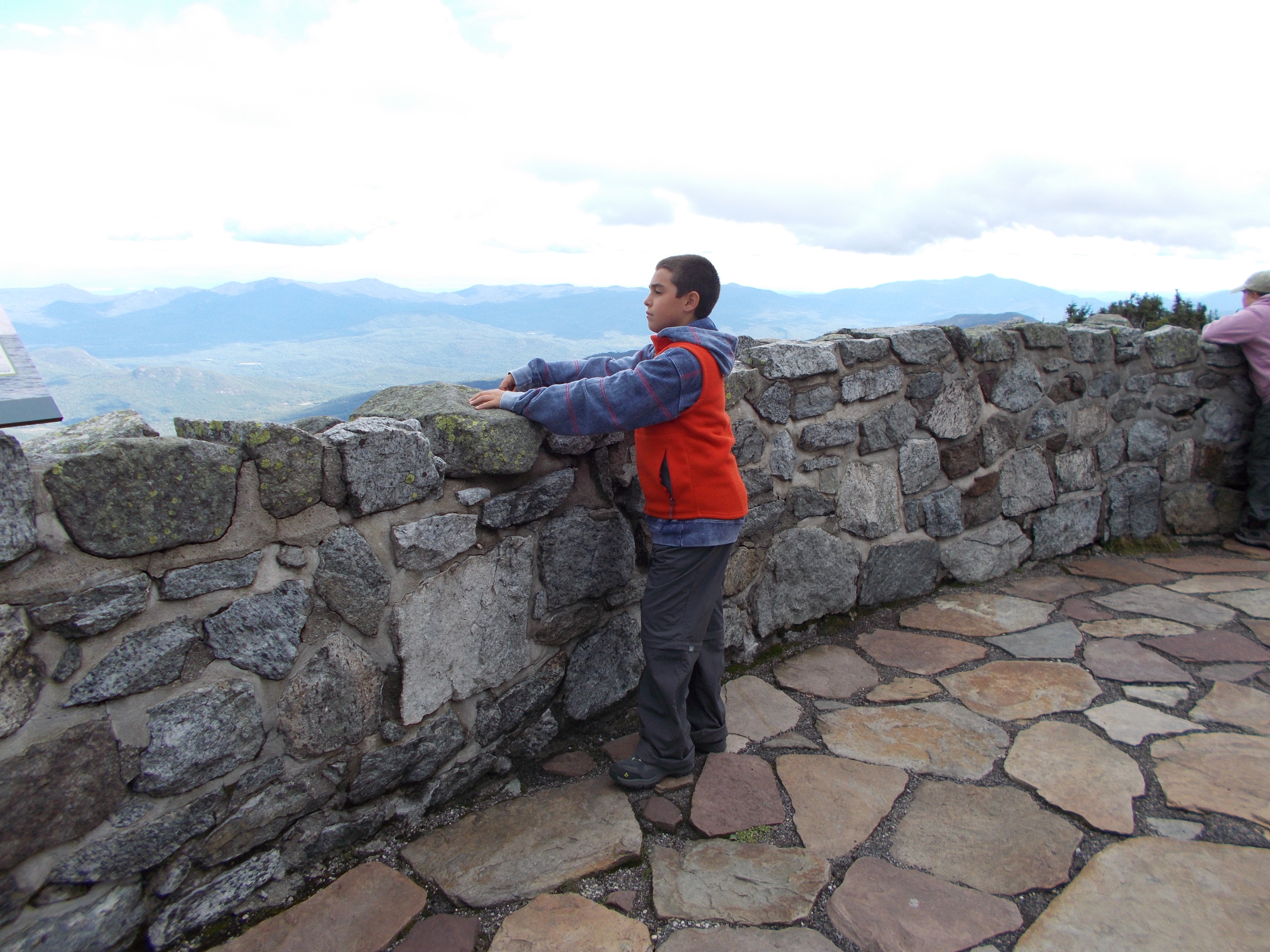
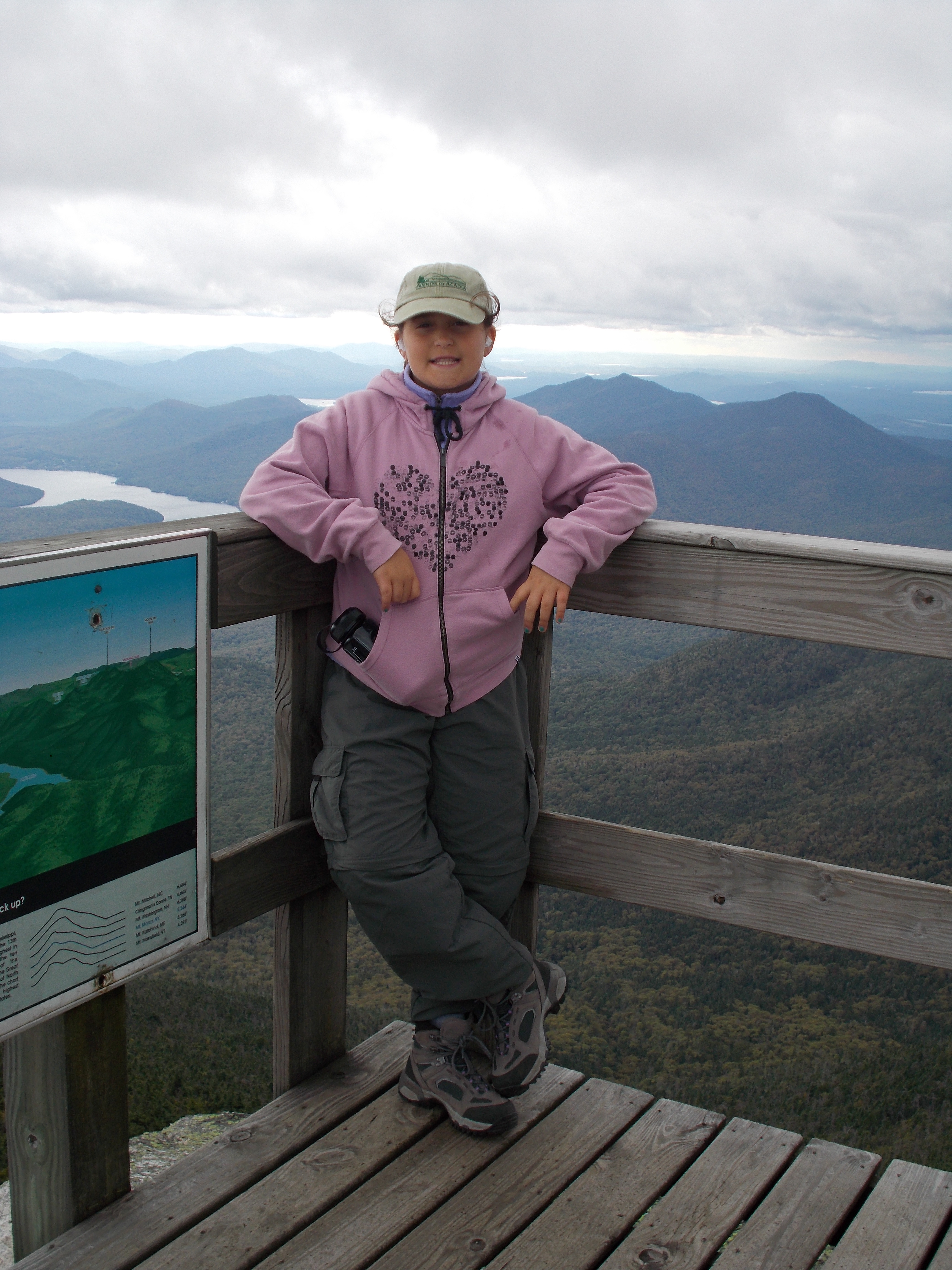
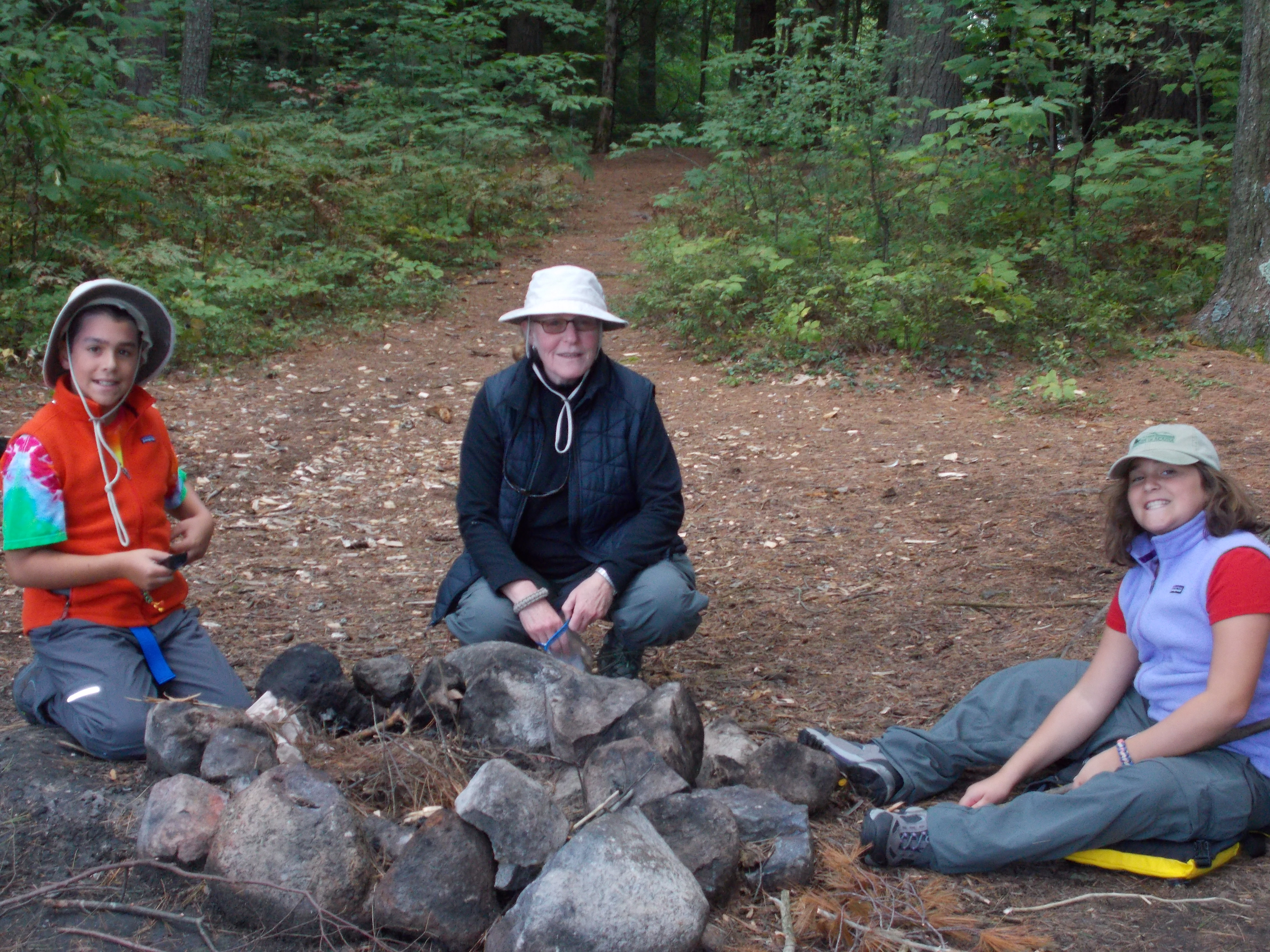
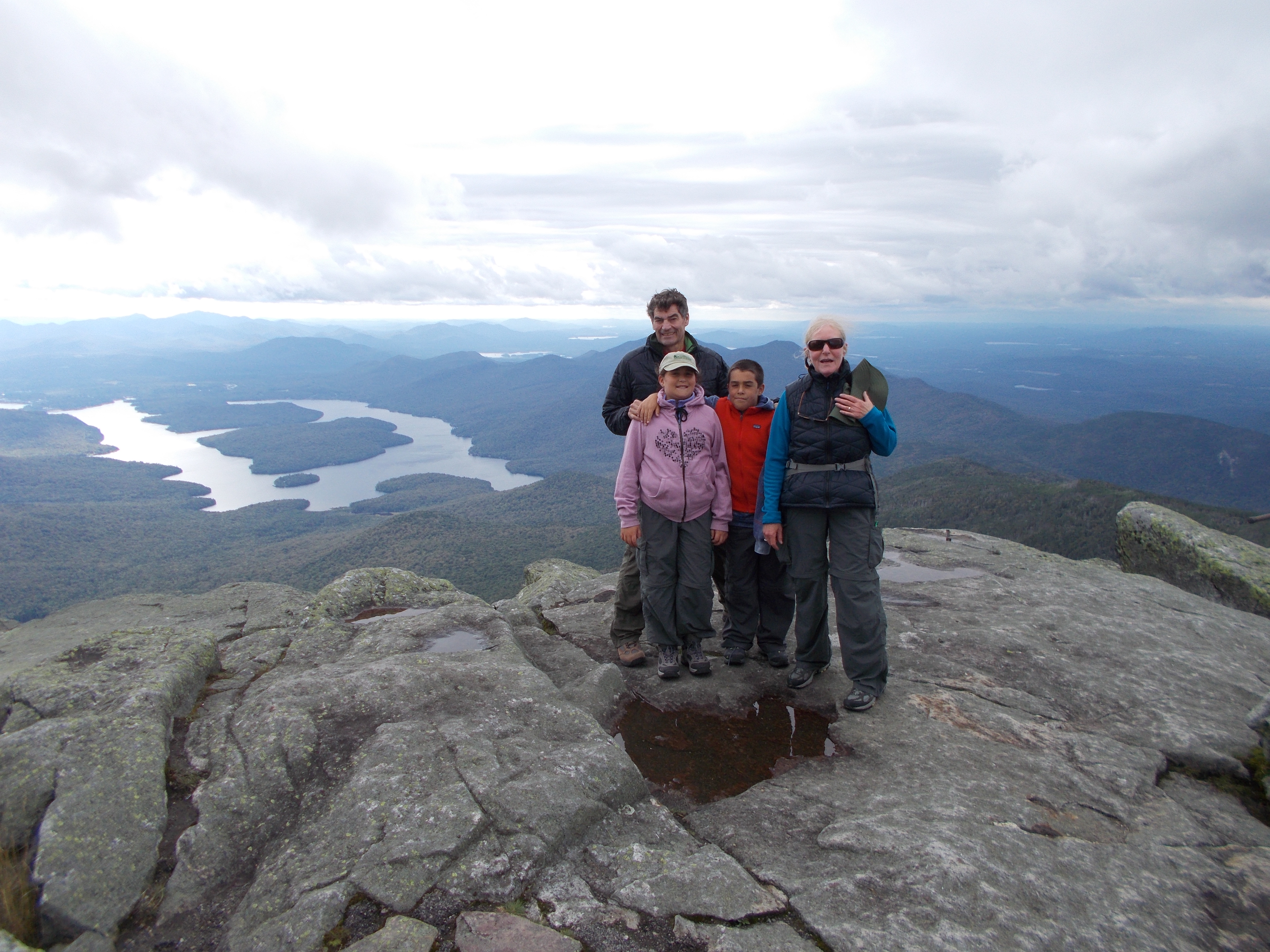
Have you ever wondered about the concept of faith as a vehicle for transportation? Margaret Sherpard, a well-known calligrapher and author, once said, “Sometimes your only available transportation is a leap of faith.” I copied the quote on one of my little yellow Post-Its and stuck it onto my refrigerator door. Every time I passed by it, I’d read the quote, mulling over the idea of a leap of faith as a form of transportation. Webster’s New Collegiate Thesaurus defines faith as a “confident belief in the truth, value, or trustworthiness of a person, idea, or thing; a belief not based on logical proof or material evidence.” I thought about the idea of the necessity to take a leap of faith not based on logic, but rather on something more ethereal and spirit-like. It has been my experience that if people were to follow their inner knowing, that inner voice that tells them what to do, even when it doesn’t seem logical, they are in a sense traveling, using faith as their vehicle of transport. It occurred to me, that if a person were to find themselves in a situation that wasn’t working for them, a place that made them feel like they had regrets, and they’d lost their sense of gratitude, that that might be the perfect time to take a leap of faith as a transport to a place of possitivity. I believe that what a person thinks is what they create. If we look at a situation negatively, it is bound to become negative. But, if we made an extra effort to view that situation from a positive place, a difficult place to be sometimes, the situation would become positive. It’s all about training your mind to think positive thoughts and to live in gratitude. Keeping spirits high for many people is constant work. Our thoughts and actions can lift our spirits and the environment we’re in. I’m convinced that being proactive, persevering, and never giving up, are necessary ingredients to the success of this form of transportation. The trick, I’ve found, is to take a break when you’re feeling overwhelmed, and get yourself outside and into nature. Soaking in the wonders of the mystical world of nature is like soaking in magic for the soul. Take a walk and open your eyes. See the world like a hawk, hear the world like an owl, smell and feel the wonder and magic inherent in the world of nature. We’re going into an orange period; the fall’s flaming leaves, a spectacular festival of colors. The fall migration has begun for the monarch butterflies, for the birds that commute, and for the migratory species of dragonflies. Are we not all spirits of nature? Humans have made living very complicated. Being aware of the beauty of the world of nature is like being at one with the universe. To be a part of the outdoors, to be in touch with the sun, the wind, and the rain, is to enter this world of magic, the world where “leap of faith transports” are readily available. The week before school started, my husband, Jack, and I took our two grandchildren, Aidan and Sarah, to hike and canoe in the Adirondack wilderness. We canoed Floodwood Pond and explored a deserted island where Sarah successfully, after many frustrating tries, built a fire with a flint and stone; we then roasted marshmallows for S’mores. They were awesome! We practiced using a compass, a good thing to know for wilderness hiking. The four of us explored the trails of the High Gorge and climbed the steep, rocky trail to the summit of Whiteface Mountain, its elevation being four thousand eight hundred and fifty-six feet. As the wind whipped about us, the air crisp and cold, we got to experience the breathtaking, panoramic views from the summit of one of the famous 46 High Peaks. When your world seems out of sorts, take that leap of faith. It’s the only thing that makes any sense in a world that prides itself on logic. It’s a remarkable and safe transport for those rare occasions when you need to journey from one place to another. There are no worries involved with lodging or reservations or food, only the idea that we trust our sixth sense, our gut feeling connected to spirit, in order to make that leap. It’s an adventurous way to travel, don’t you think?

DSCN0368Visitors from Canada took this picture of us. We were standing on the bridge that led us into the trails of the High Gorge. The Ausable River, a well-known river for trout fishing, is flowing under the bridge, heading toward the coast.DSCN0376DSCN0380DSCN0383Here we are on the top of Whiteface Mountain. The wind was kicking up a storm that day. There was so much energy in the air. It was awesome!
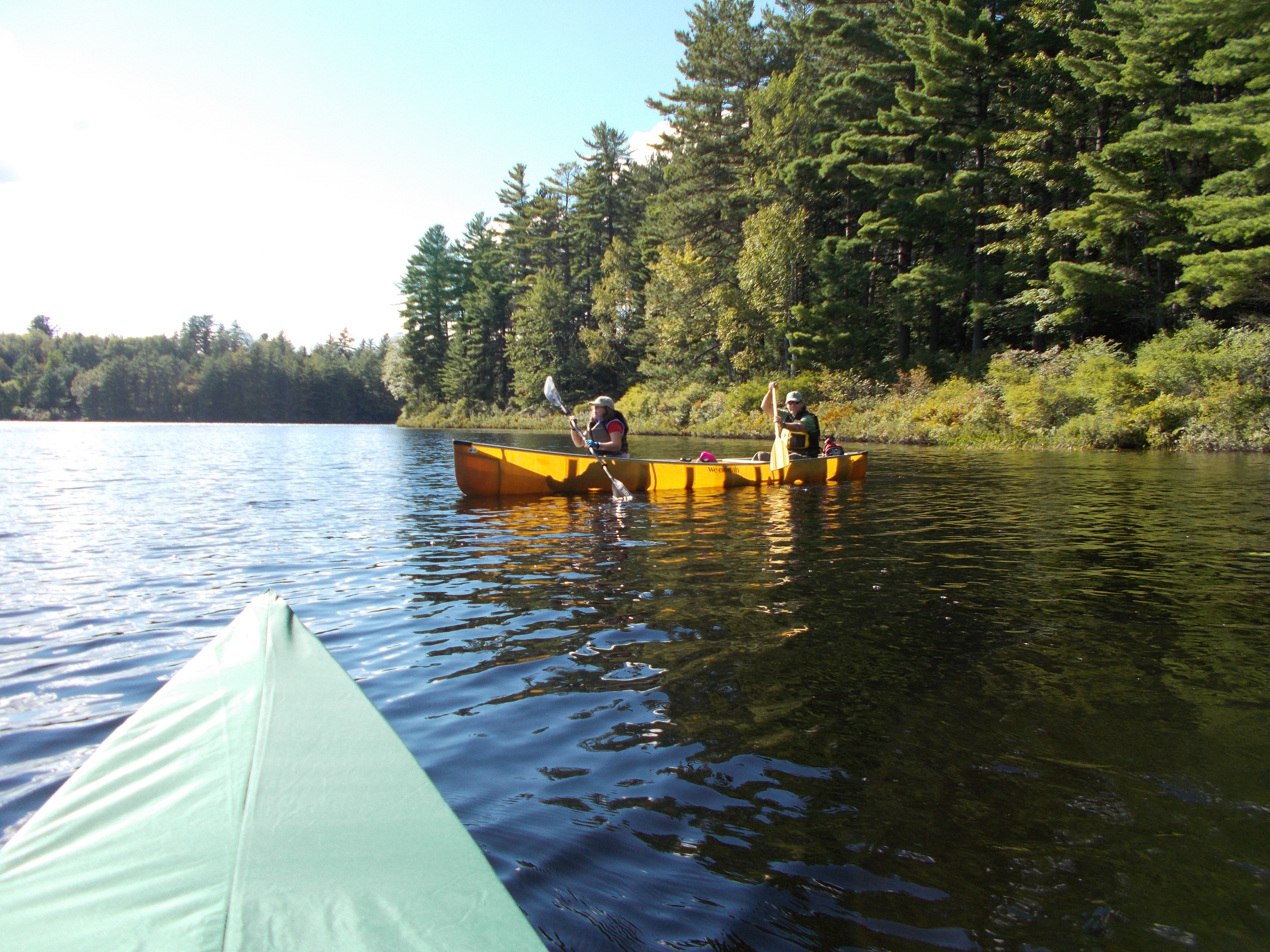
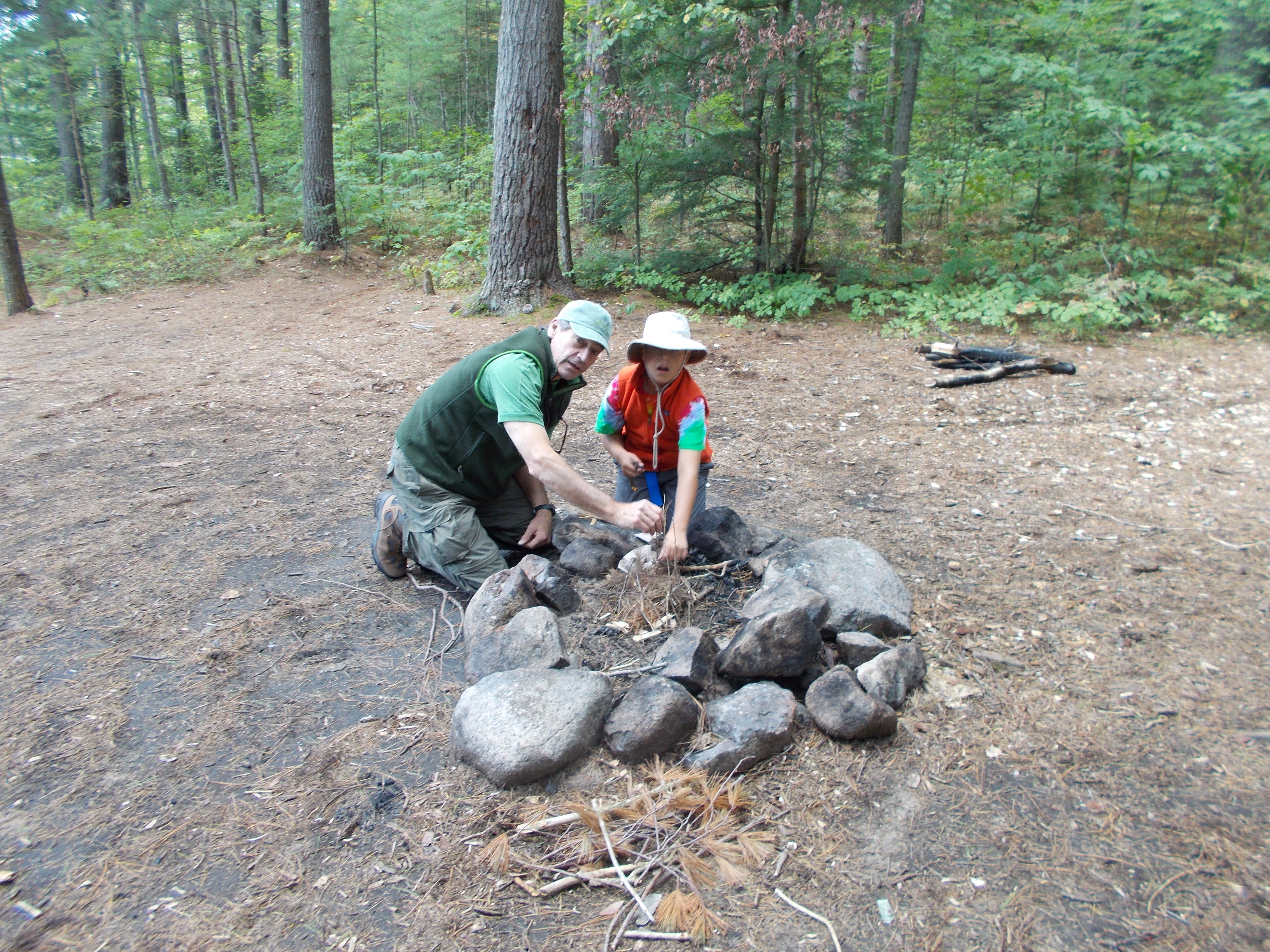
DSCN0397DSCN0387DSCN0390These are shots from the deserted island we canoed to in Floodwood Pond. Sarah finally got the spark that ignited our fire. What a blast!

Owling

Full moon names date back to Native Americans from the northern and eastern United States. It was a way for the tribes to keep track of the seasons. The Algonquin tribes referred to the full moon of January as the Wolf Moon. During the frigid midwinter, the hungry wolf packs would howl outside the villages of the Indian tribes. Thus, the name for January’s full moon. There is a chapter in my new YA novel, The Bread Crumb Trail, where the characters go owling. It  always helps to write what you know, so, I invited my husband to join me on an owling adventure. Serendipity struck and I located a class that was offering the experience of calling in an owl from the wild. I had heard many stories from fellow birders on their own success with calling in the owls and I wanted to have the experience first hand. The class was everything I had imagined it would be. The instructor successfully called in an Eastern Screech Owl. The Great Horned Owl didn’t show up, though. One out of two was okay with me. This past Wolf Moon, my husband and I ventured out to call in an Eastern Screech Owl, a permanent resident in our area. It’s the most common owl found on Long Island and it mates for life. It comes in two different colors, either gray or red. It breeds in cavities of trees, but will also use a nest box if they discover one. They are rarely seen during the day and their flight is completely silent due to their feathers. These medium sized owls measure about ten inches in height with a wing span of about eighteen inches. Sometime during the end of the month of March, they lay three to four eggs. The eggs incubate for thirty days. When the eggs hatch, they become nestlings for thirty days. The downy chicks remain with the parents for another six weeks. Sometime at the beginning of July, they leave the nest to fend for themselves. The weather was frigid on the eve of this past Wolf Moon. We bundled up in layers, put our binoculars around our necks, and headed to a location where both the Great Horned Owl and the Eastern Screech Owl had been spotted. I had downloaded the call of the Eastern Screech Owl onto my Samsung phone, put the volume up to high, and hoped for the best. Most vocalizations of the Eastern Screech Owls are trill-like. Males use trills in many situations, including territorial defense. The hoot, a soft, low-pitched hoot, is given when the owls suspect intruders or potential predators. The screech is a single loud, piercing call, followed by the trill vocalizations. We’d been told that depending on how the sound traveled and the mood of the owl on any particular night, the owl might appear or it might not. We stood in silence as I played the call of the Eastern Screech Owl, shivering and excited and hopeful. We listened, but no response. I played the call once again, and to our surprise an owl responded from deep within the forest. I played the call again, and this time the owl’s response sounded so much closer. We were nervous and excited. It was so cold outside and the moon was so bright we could see out breaths floating up towards the trees. Could we really be calling in an owl? I played the call one more time. Something inside me told me that the owl had arrived. I told my husband to shine the high-powered flashlight up into the big pine tree that stood in front of us. My husband whispered to me that there was nothing there.The thing is, though, I could feel its presence. I insisted he shine the light up into the trees and there the owl sat, nestled on a thick branch staring directly down at us. His big yellow eyes peered through the darkness like two tiny suns, his color was a brownish-red. I put my binoculars up to my eyes and stared right back at it. He turned his head in crazy directions and ruffled his feathers. It really did have a silent flight. It was absolutely amazing. After about six minutes, I played the call one more time and he spread his wings and swooped down on us, checking out if we were going to threaten him in his territory. We flinched and smiled and laughed. We had done it. We had called in an owl. My husband turned to me, gave me a kiss on the cheek, and called me an owl whisperer. How cool, I thought to myself.  What a spectacular full moon night it had been!

Earth Hour 2013

Earth Hour began in Sydney, Australia, in 2007, when 2.2 million homes and businesses switched off their lights for one hour to raise awareness about the impact of power generation on global climate change. In 2008, the event grew into a global movement, with 50 million people switching off their lights. In 2009, close to 1 billion people participated globally. Global landmarks such as the Empire State Building in NYC, The Golden Gate Bridge in San Francisco, Rome’s Coliseum, the Sydney Opera House, and the Coco Cola billboard in Times Square all stood in darkness. The idea of Earth Hour was conceived by the World Wilflife Fund (WWF) as a way to raise awareness among the general public about climate change and to convey that , by working together, each of us can make a difference. Earth Hour’s non-partisan approach has captured the world’s imagination and become a global phenomenon. This year, on Saturday, March 23, 2013, at 8:30 p.m., millions of people around the world will come together to take a stand to protect our planet against climate change. They will do something quite simple – turn off their lights for just one hour and show that one person can make a difference and millions of people working together can change the world. WHY EARTH HOUR? To warm, cool, and light our homes, schools, and businesses we use energy. Energy also gets us where we need to go. To make energy we burn fossil fuel. Burning fuels adds gases to the air and changes the weather. It’s a big problem called climate change. EVERY DAY IS EARTH DAY! EVERY HOUR IS EARTH HOUR! Earth Hour is not just about one hour; it’s about making long term changes to the way we use energy, both in the workplace and at home. SIX EASY WAYS YOU CAN DO YOUR PART! . Turn off lights, TV, and computer when you leave a room . Use energy efficient light bulbs and appliances . Travel green – walk, bike, or carpool when you can . Adjust your thermostat . Whenever possible, wash laundry in cold water and air-dry clothes; Only run the dishwasher when it’s full . Save and plant trees. Reduce, reuse, and recycle paper, plastic, glass, and aluminum Every individual, every business, and every community around the world is encouraged to switch off all non-essential lights for one hour to make a large collective statement of concern over global climate change and illustrate the need for solidarity in finding solutions. VOTE EARTH! Earth-Hour-Poster

Woman in the Glass

When you get what you want in your struggle for self, And the world makes you queen for a day. Just go to the mirror and look at yourself and see what that gal has to say – For it isn’t your husband or family or friend whose judgment upon you must pass. The gal whose verdict counts most in the end, is the one staring back in the glass. Some people may think you’re a straight shooting chum, and call you a person of place. But the gal in the glass says you’re only a bum, if you can’t look her straight in the face. She’s the gal to please, never mind the rest, for she’s with you clear up to the end. And you’ve passed a most dangerous difficult test, if the gal in the glass is your friend. You may fool the whole world down the pathways of years – and get pats on the back at your pass. But your final reward will be heartaches and tears, if you’ve cheated the gal in the glass.” Anonymous