

Banned Books
Historically, the banning and censorship of books is not new, but in this chaotic, troubled age of mass media and AI, both powerful tools, the shaping of human consciousness through ideological control marks a new wave of tampering with intellectual freedom. The motive? To disrupt social stability. How? By creating a nation based on ideological conformity. If intellectual freedom, the foundation of a free society, is challenged, censored, or banned, what are we left with? A flock of complacent sheep, addicted to cell phones, large-screen TVs, streaming, and social media platforms, all tracked by government surveillance. When books are stolen from students, either by removing them from library shelves or banning them from schools, censorship has taken place. This action of expurgating books, disguised as protection for our children, threatens the First Amendment principles of freedom of expression.
In the September 22, 2016, issue of Literary Pub, Amy Brady, the executive director of Orion magazine, wrote that, “Like smallpox and vinyl records, book banning is something many Americans like to think of as history,” but that is far from the truth. Since July 2021, PEN America recorded, “22,810 cases of book bans across 45 states and 451 school districts.” The normalization of book expurgation, a movement that has surged in American schools and libraries across America, erases books that are deemed controversial, books that open minds to different ideas and opinions, produce meaningful discussions, and alters the possibilities and curiosities of students to question the prevailing social, economic, political, and cultural norms of present day society. The justifications for these censorships and the banning of books include, but are not limited to, objections that the contents of the books are graphically violent, sexually explicit, morally inappropriate, politically biased, or that they promote profanity, examine critical race theory, challenge social norms, encourage drug use and homosexuality, or contain elements of magic and witchcraft that conflict with religious beliefs.
Carl Sagan, a former Cornell professor and planetary scientist, said it best:
Books are repositories of human wisdom and creativity.
What an astonishing thing a book is. One glance at it and you’re inside
another person, maybe somebody dead for thousands of years across the millennia,
an author speaking clearly and silently inside your head, directly to you.
Writing is perhaps the greatest of human inventions, binding together people who never
knew each other, citizens of distant ages, who break the shackles of time.
Books are like seeds. They can lie dormant for centuries, but they may also produce
flowers in the most unpromising soil.
Many of the most controversial works of literature are now considered to be classics, literary works that remain relevant today. These classics explore universal themes of the human condition, influence cultural and social ideology, and brilliantly demonstrate mastery of the elements of the writer’s craft. In Woman of Letters, Naomi Kanakia pointed out that it is the opinion of “Many historians that Harriet Beecher Stowe’s Uncle Tom’s Cabin was the first book in the United States to experience a ban on a national scale.” In her essay, Uncle Tom’s Cabin is the Great American Novel, she goes on to say that “The Confederacy barred the book from stores not only for its pro-abolitionist agenda, but because it aroused heated debates about slavery.” Published in 1852, its impact was immediate, as it became the most sort after novel in the 19th century, exposing the racial tensions of the times and the evils of slavery, a system that exploited and dehumanized enslaved people.
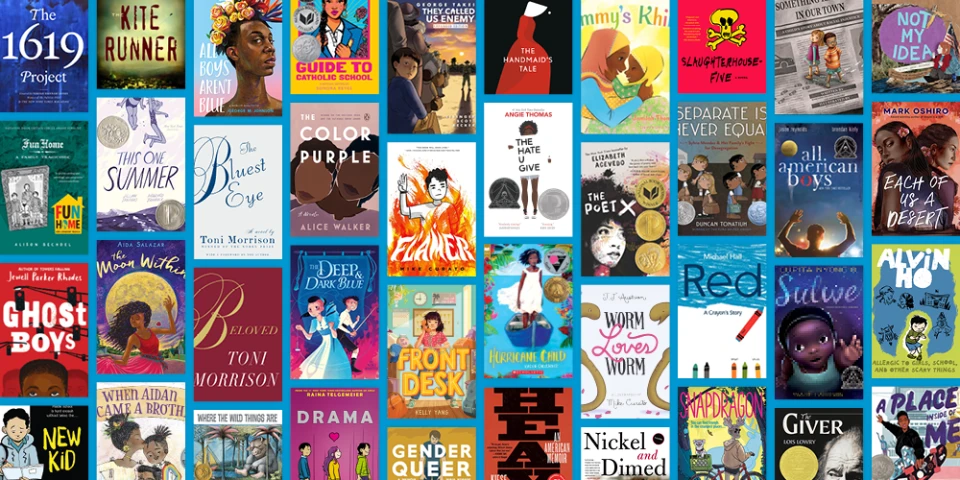
Tell a student a book is banned, and that’s the book they’ll seek. Engaging students to read, using books that deal with highly charged topics, is like a shark to blood. Through the close readings of such books as To Kill a Mockingbird by Harper Lee, Uncle Tom’s Cabin by Harriet Beecher Stowe, Beloved by Toni Morrison, or The Adventures of Huckleberry Finn by Mark Twain, a student examines critical issues surrounding racism. A poem like Allen Ginsberg’s Howl, or novels like The Bluest Eye by Toni Morrison, The Absolutely True Diary of a Part-Time Indian by Sherman Alexie, The Chocolate Wars by Robert Cormier, or Go Tell it on the Mountain by James Baldwin expose students to gender and sexuality themes. Issues that relate to government surveillance, propaganda, and violence are found in such classics as 1984 and Animal Farm by George Orwell, Brave New World by Aldous Huxley, Lord of the Flies by William Golding, Slaughterhouse Five by Kurt Vonnegut, The Handmaid’s Tale by Margaret Atwood, and The Diary of Anne Frank by Anne Frank. The opposition to such works as the Harry Potter Series by J.K. Rowling, The Scarlet Letter by Nathaniel Hawthorne, or A Portrait of the Artist as a Young Man by James Joyce stem from cultural and religious beliefs. All these skillfully written literary works have been banned at one time or another, taken out of circulation only to be replaced after guardians of the shelves voiced their opposition and fought for intellectual freedom and a student’s right to read.
The critical questions of how to approach discussions and disagreements surrounding the issues of why a book is censored or removed from a library shelf are as important as the works themselves. Learning to remain civil when there are differences in opinion is a skill that needs to be taught and practiced so that new perspectives can be explored. Given the opportunity to use literature as a vehicle to develop skills of critical thinking, meaningful engagement with a variety of controversial texts, and the opportunity to develop complex analytical, persuasive arguments is a gift each of our students deserve. As a lifelong learner and teacher, I strive to achieve excellence in the pursuit of knowledge and value the opportunity to challenge students to think critically. At the heart of every great novel there exists the opportunity to grow, exchange ideas, and understand the human condition through the lens of curiosity, empathy, and tolerance. Stand up to censorship and voice your opinion. If not now, when?
(The above image is taken from The New York Public Library)