


Camp Siegfried
Once upon a time there was a summer camp on Long Island that taught Nazi ideology, a camp with no conscience or moral responsibility. Strategically located by Camp Upton’s military facility, now known as the Brookhaven National Laboratory, Camp Siegfried was one of twenty-five Nazi youth camps that spread like a plague across the United States of America. This sleeper cell, disguised as an enchanted summer get-away camp for children of German lineage and an entertainment campground where German adults could explore the rural outdoors, swim in the freshwaters of Upper Yaphank Lake, known then as Swezey’s Pond, and drink lots of Schaefer and Lowenbrau beer, was the perfect cover to prepare the fragile youth for leadership roles once the Nazis took over America. But behind this facade, a dark mission of indoctrination to embrace Aryan racial superiority could be heard on a quiet summer evening breeze as the campers gathered around the bonfires to sing the Nazi national anthem that called for the spilling of Jewish blood followed by the Hitler salute and the shoutout of “Sieg Heil.”
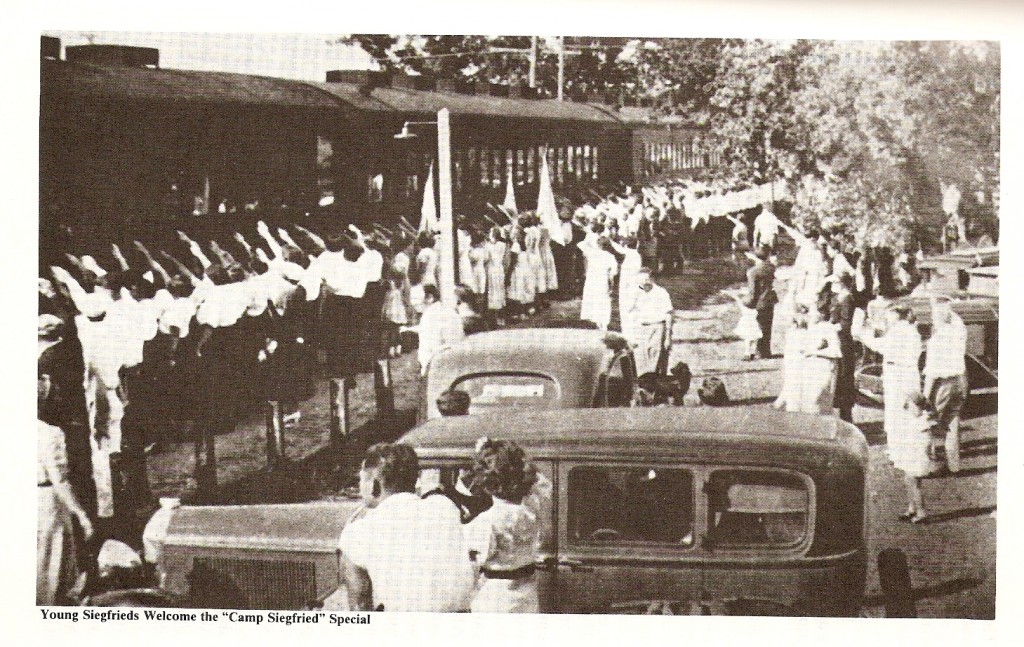
Camp Siegfried opened its doors in 1935, under the leadership of Kritz Kuhn, a naturalized citizen of the United States, who was proud to be known as the American Fuehrer and the head of the German American Bund. His leadership encouraged the grooming of Aryan children, under the fluttering flags of the German swastika, to dress as Hitler’s youth as they physically trained, learned outdoor survival skills, and achieved proficiency using firearms. For the thousands of adults that attended weekend rallies, the draw was a reminder of the summer lodgings they’d left behind in the fatherland. On any given summer weekend, 40,000 visitors would arrive to drink sometimes up to 10,000 gallons of beer, sing om-pa-pa songs, and partake in the festivities. Some would drive to the camp while others would travel from Penn Station on the “Siegfried Special.” Upon the train’s arrival at the Yaphank railroad depot, camp youth members, dressed in their Hitler youth uniforms, would greet the visitors with the Nazi salute. Together, they’d parade through the streets of Yaphank, a small farming town in Suffolk County, until they reached the entrance to the camp. To protect the marchers, Kuhn organized hundreds of storm troopers to watch over them as the loudspeakers poured forth antisemitic speeches. By 1937, however, suspicions grew within the community as local, state, and federal governments began to question the dark goings-on at the camp.
In 1938, Marvin Miller, a local history teacher from Commack High School, published a novel about Camp Siegfried entitled Wunderlich’s Salute in which he noted that “In the 1930s, one of every seven inhabitants in Suffolk County belonged to the Ku Klux Klan, and were especially well represented in Yaphank.” The town was a perfect wooded lakefront environment to breed the cancer of hate.
Arnie Bernstein’s novel Swastika Nation pointed out that the hidden truth behind this wholesome haven was “the emotional, intellectual, sexual, and physical abuse of the children.” Only German was allowed to be spoken at the camp. If anyone by mistake spoke English, they were punished. Goosestepping was practiced daily as was the forced studies of German culture which was followed by rigorous written tests. Mark Furr, in his article entitled “Camp Siegfried: Just Another Regular Long Island Summer Camp-with a Nazi Twist,” acknowledged that “Campers were woken during the middle of the night, forced to strap on thirty-pound packs and hike through bramble-covered trails, often getting cut up as they marched along.” The more scratched up they got the more praise they’d received. Forced child labor to construct camp facilities was employed by Bund leaders to avoid paying union members they believed were Communists and Jews.
In addition to Nazi indoctrination, Kuhn, like Hitler, desired to breed more Aryans. This was accomplished through dissemination of propaganda, the allowance of teen consumption of beer, and the encouragement of teen boys to be sexually active with teen girls, many of which left summer camp pregnant. Accounts emerged years after the closure of the camp that male counselors had forced themselves on female campers against their will, a practice that was not frowned upon by camp directors. One of the youth leaders, Tillie Koch, was so distraught about the immorality taking place at Camp Siegfried, that she chose to stand outside of the girls’ tent to protect the girls from sexual harassment. Over several days of driving, cold rains, she contracted pneumonia and died. Her death could have been avoided if a doctor had been called, but Bund leaders felt that she’d been a threat and hadn’t demonstrated the loyalty and tenacity a German should exhibit.
On February 20, 1939, 20,000 German Americans marched through the streets of Manhattan, waving German swastika flags alongside American flags. They gathered at a rally in Madison Square Garden where Fritz Kuhn orchestrated the largest Nazi assembly in America. Shocked by the display, New York District Attorney Thomas Dewey went after Kuhn on tax evasion charges, accusing and then proving that he’d been skimming money from the Bund and from the coffers of Camp Siegfried. In August of the same year, an investigation of un-American propaganda activities in the United States took place. Hearings, organized by Representative Samuel Dickson, a Democrat from New York, were held in the House of Representatives in Washington, D.C.; the presiding chairman was Hon. Martin Dies. During this investigation, testimony was heard from key witnesses that were concerned about subversive, Communist activities. Included in those hearings were interviews with several key witnesses, two of which were the Bund leader, Fritz Kuhn, and Helen Vooros, a Brooklyn Bund youth leader and friend of the deceased, Tilly Koch. Helen met Tillie during a Bund meeting in Brooklyn. Over the course of their friendship Tillie had shared with Helen her concerns about immorality taking place at Camp Siegfried. Helen, age 19, bravely agreed to be interviewed by the House committee where she confessed that on a trip to Germany, paid for by the German American Bund, she’d been sexually assaulted by a Bund leader. When asked at the hearing if this practice of allowing boys and girls to follow their instincts was moral, she confessed that she was taught that breeding more Aryans inspired purity for their race. When asked why she left the movement, Helen shared that she was disgusted by camp conduct and needed to stand up to the horrific teachings of the Bund. At one point in her testimony Helen shared:
They tell us that we are pure Aryans, and that we are not to mingle with any other race because they say that would be the most disgusting thing that could happen. They say that our race would be ruined…Small children, from 8 to 12 years old, are given books published by Julius Streicher, an antisemitic German publicist. They are the kind of books that children would get in kindergarten. They would have pictures of Jews with blood dripping fingers, and under the picture there would be rhymes. We were told that later we could have children, and that our children were to be in favor of the same government…that is, the German Nazi theory of government, because it was the only way to get along. There were three groups. The other two groups were ages 12 to 14, and 14 to 18. The oldest groups were taught to spread propaganda…We were forced to read Hitler’s Mein Kampf and books by Julius Streicher…Girls’ main purpose was to birth more Aryans…Boys to be soldiers.
The final blow to Camp Siegfried took place in November of 1939 when Judge Gustav Neuss, a Justice of the Peace in Yaphank, who’d consistently opposed the Bund’s presence on Long Island, requested the Brookhaven Town’s Alcoholic Beverage Board to rescind Camp Siegfried’s liquor license. The camp never recovered from the board’s action.
Fritz Kuhn was deported after the war, imprisoned, and died in Germany in 1951. Julius Streicher, who’d provided fodder for the children of these youth camps, ended up as a convicted war criminal. He was hanged in Nuremberg on October 16, 1946.
The spread of hate that flourished in Camp Siegfried is captured in the lyrics of Rogers and Hammerstein’s song, “You’ve got to be Carefully Taught:”
You’ve got to be taught to hate and fear,
You’ve got to be taught from year to year,
It’s got to be drummed in your dear little ear-
You’ve got to be carefully taught!
You’ve got to be taught to be afraid
Of people whose eyes are oddly made,
And people whose skin is a different shade-
You’ve got to be carefully taught!
You’ve got to be taught before it’s too late,
Before you are six or seven or eight,
To hate all the people your relatives hate-
You’ve got to be carefully taught!
This glimpse into an unknown 1930s page in Long Island history, reveals the dark dangers of extremism, prejudice, and hatred that still echoes throughout our country and around the world. The power of propaganda and the spewing of hatred for specific groups of people is a reminder that we must never be complacent and never look away.
(The picture above is taken at the Long Island Railroad in Yaphank Station where visitors were greeted by Bundists campers, courtesy of Marvin Miller’s Wunderlich’s Salute)